Turn on screen reader support
To enable screen reader support, press Ctrl+Alt+Z To learn about keyboard shortcuts, press Ctrl+slash
Turn on screen reader support
To enable screen reader support, press Ctrl+Alt+Z To learn about keyboard shortcuts, press Ctrl+slash

Aggregate Piers, Ground Improvement
The Benefits of Aggregate Piers for Large Footprint Buildings
July 18, 2026
Large footprint buildings present unique foundation challenges. Warehouses, manufacturing facilities, distribution centers, retail developments, and other expansive structures place significant demands on the soils beneath them.
When poor or variable soils are present, project teams often face difficult decisions. Should they over-excavate? Switch to deep foundations? Redesign the structure?
In many cases, aggregate piers provide a more efficient solution.
By improving existing soils rather than replacing them, aggregate piers can increase bearing capacity, reduce settlement, and help keep projects on schedule. For general contractors and engineers, they often offer a practical balance between performance, cost, and constructability.
If you’re unfamiliar with how they work, explore CNC Foundations’ Aggregate Piers page to learn more about the system and its applications.
Why Large Footprint Buildings Require Special Foundation Consideration
Unlike smaller buildings, large footprint structures distribute loads across thousands, sometimes hundreds of thousands, of square feet.
That means even small amounts of differential settlement can create significant issues over time, including:
- Cracked slabs
- Uneven floors
- Structural movement
- Operational disruptions
- Costly repairs
The larger the building, the more important it becomes to create consistent support across the entire footprint.
Aggregate Piers Improve Weak Soils Without Deep Foundations
One of the biggest advantages of aggregate piers is their ability to strengthen weak soils while allowing many projects to utilize conventional shallow foundations.
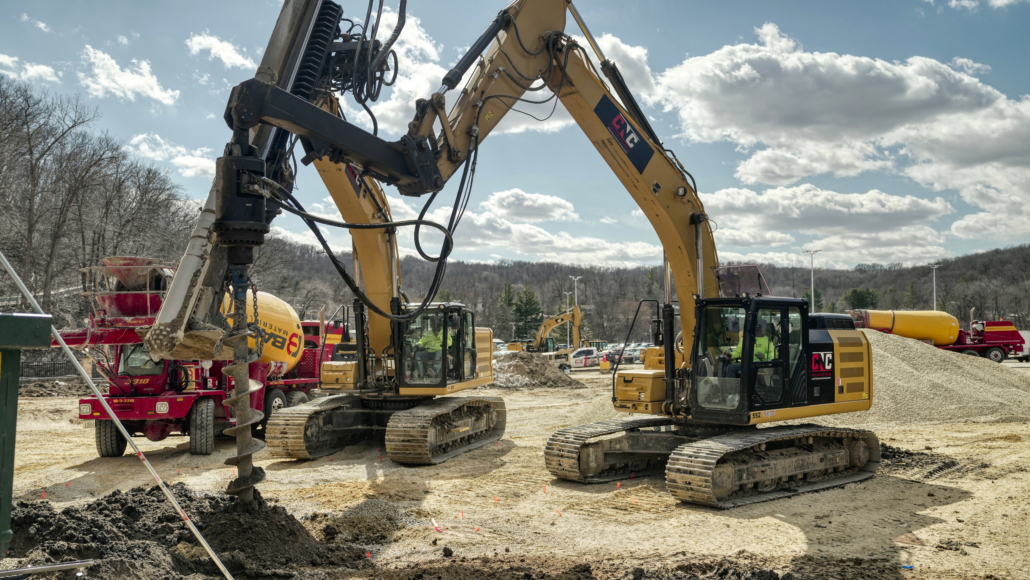
Aggregate piers are compacted columns of stone installed within soft or compressible soils. As they’re installed, they densify and reinforce the surrounding soil, increasing bearing capacity while reducing settlement.
Compared to deep foundation systems, aggregate piers can often:
- Reduce foundation costs
- Minimize excavation
- Generate fewer spoils
- Accelerate installation
- Simplify foundation construction
For many commercial projects, these benefits translate directly into schedule and budget savings.
Faster Installation Helps Keep Projects Moving
General contractors know that foundation work sets the pace for everything that follows.
Because aggregate piers can often be installed more quickly than deep foundation alternatives, they help projects move into footing and slab construction sooner. CNC’s installation methods also minimize spoils, reducing trucking and site disruption while improving overall efficiency.
That means:
- Concrete crews can mobilize earlier.
- Structural steel schedules stay on track.
- Follow-on trades experience fewer delays.
- Owners reach occupancy sooner.
When every week matters, those schedule gains can have a meaningful impact on the overall project.
Reducing Risk for General Contractors
Unexpected subsurface conditions are one of the leading causes of project uncertainty.
Aggregate piers help reduce that uncertainty by creating a more predictable foundation system capable of supporting shallow foundations while controlling settlement.
When paired with early collaboration between the geotechnical engineer, structural engineer, and ground improvement contractor, aggregate piers can help reduce:
- Design changes
- Schedule delays
- Cost overruns
- Long-term settlement concerns
- Construction risk
The result is a more efficient path from design through construction.
Proven Performance on Large Commercial Projects
Aggregate piers have been successfully used on a wide variety of large commercial and industrial projects.
For example, CNC Foundations installed aggregate piers at the Casino Queen Marquette expansion in Iowa. Located near the Mississippi River, the project involved challenging alluvial soils beneath a 100-by-150-foot clear-span building addition. CNC utilized both Vibratory Stone Columns and Grouted Vibratory Stone Columns to provide the required foundation support while minimizing disruption and meeting the project’s schedule.
On another project, the Chelsea Point development near Boston required more than 1,900 rigid inclusions to support a 135,000-square-foot industrial facility in a dense urban environment. While this project utilized rigid inclusions rather than aggregate piers, it demonstrates CNC’s ability to evaluate site conditions and recommend the ground improvement solution best suited to each project’s performance requirements. Choosing the right system, rather than a one-size-fits-all approach, is critical to successful outcomes.
Choosing the Right Ground Improvement Solution
Not every project is best served by aggregate piers.
Soil conditions, groundwater, structural loads, and project goals all influence the appropriate ground improvement method.
That’s why involving a ground improvement contractor during preconstruction is so valuable. Early collaboration allows the project team to evaluate options, optimize the foundation system, and avoid costly redesigns later in the project.
Partner with CNC Foundations
At CNC Foundations, we partner with general contractors, developers, geotechnical engineers, and structural engineers to develop ground improvement solutions that support both project performance and construction schedules.
Our in-house engineering team evaluates each site’s unique conditions to determine whether aggregate piers or another ground improvement solution is the best fit.
Whether you’re planning a warehouse, manufacturing facility, commercial development, or another large footprint project, we’re here to help you build on a stronger foundation.
Have a project with challenging soil conditions? Contact CNC Foundations to discuss your project.