Turn on screen reader support
To enable screen reader support, press Ctrl+Alt+Z To learn about keyboard shortcuts, press Ctrl+slash
Turn on screen reader support
To enable screen reader support, press Ctrl+Alt+Z To learn about keyboard shortcuts, press Ctrl+slash

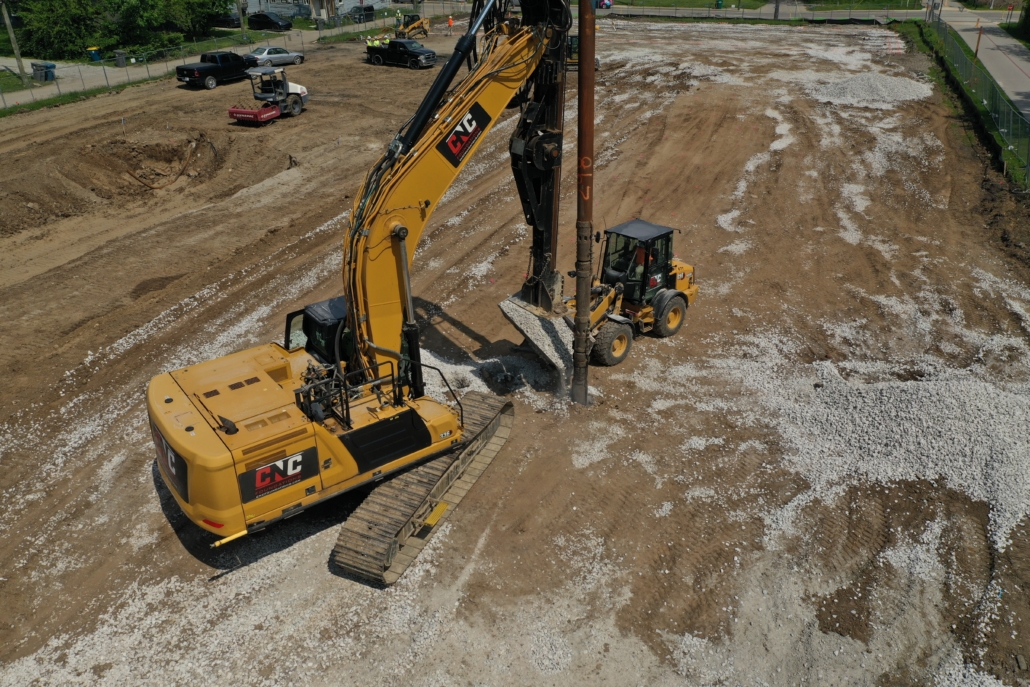
Aggregate Piers, Ground Improvement
Building on Challenging Soils: How Aggregate Piers Keep Projects Moving
August 18, 2026
When you’re building a warehouse, distribution center, manufacturing facility, student housing complex, or another large footprint building, you know one thing is almost guaranteed.
The geotechnical report is going to have something that keeps everyone up at night.
Maybe it’s soft clay. Maybe it’s uncontrolled fill. Maybe it’s settlement concerns.
Whatever it is, poor soil has a way of creating bigger problems if it’s not addressed early.
The good news is that it doesn’t always mean you need to over-excavate or switch to an expensive deep foundation system. In many cases, aggregate piers provide a practical solution that helps keep projects moving while controlling both costs and risk.
If you’re not familiar with how they work, check out our Aggregate Piers page for an overview of the system.
Large Buildings Come With Big Expectations
Large footprint buildings don’t leave much room for surprises.
Owners expect projects to stay on schedule. Budgets are tight. Every trade is waiting on the one before them. When you’re managing a project of this size, even a small delay in foundation work can ripple through the entire schedule.
That’s why ground improvement has become such an important part of preconstruction. When the right solution is identified early, the project team has more flexibility, fewer unknowns, and a better chance of keeping construction moving as planned.
Aggregate Piers Help You Build on Challenging Soils
Think of aggregate piers as a way to improve the ground you’re already working with instead of trying to replace it.
Using specialized equipment, compacted stone columns are installed into weak soils to create a stronger foundation system. The improved ground is better able to support structural loads while reducing settlement, allowing many projects to utilize conventional shallow foundations.
For general contractors, that often translates into practical benefits such as:
- Less excavation
- Reduced settlement
- Improved bearing capacity
- Greater confidence in the foundation system
- Fewer surprises during construction
Every site is different, but when aggregate piers are the right fit, they can simplify the path forward.
Want to understand how aggregate piers improve soil performance? Read our blog, The Science and Engineering Behind Aggregate Piers, for a closer look at the engineering principles behind the system.
Less Excavation Often Means Less Risk
Anyone who’s managed a large project knows excavation has a way of snowballing. What starts as removing unsuitable soil can quickly lead to additional trucking, imported fill, testing, weather delays, and unexpected site conditions.
Because aggregate piers improve the existing soils instead of removing them, many projects can avoid much of that extra work. The result is often a cleaner, more predictable construction process with fewer moving parts to manage.
Reducing excavation can also help:
- Minimize trucking and site traffic
- Reduce imported fill requirements
- Limit weather-related delays
- Keep crews focused on construction instead of earthwork
Keeping the Schedule Moving
Foundation work sets the pace for everything that follows. If the foundation falls behind, it’s difficult for the rest of the project to make up that lost time.
When aggregate piers are the right solution, installation can often be completed efficiently, allowing footing and slab work to begin sooner than some traditional alternatives.
That momentum benefits everyone on the project by helping:
- Concrete crews stay on schedule
- Structural steel erection begin as planned
- Follow-on trades avoid unnecessary delays
- Owners move closer to occupancy
Better Soil Means Fewer Surprises
One of the biggest advantages of aggregate piers isn’t something you’ll necessarily notice once the building is complete. It’s the confidence that comes from knowing the ground has been engineered to perform as expected.
By increasing bearing capacity and reducing settlement, aggregate piers help reduce the likelihood of issues such as cracked slabs, uneven floors, or unexpected movement. While no foundation system can eliminate every risk, improving the ground early gives the entire project a stronger starting point.
It Starts With the Right Team
Successful ground improvement projects rarely come down to choosing one product over another. They come from getting the right people involved at the right time.
When the ground improvement contractor, geotechnical engineer, structural engineer, and general contractor collaborate during preconstruction, they have the opportunity to review the site’s conditions, evaluate multiple options, and select the solution that best fits the project’s goals.
That early collaboration helps teams:
- Review the geotechnical report together
- Compare foundation alternatives
- Reduce redesigns later in the project
- Identify risks before construction begins
Sometimes the right answer is aggregate piers. Sometimes it’s another ground improvement solution. The goal is always the same: find the approach that gives the project the best chance for success.
Proven on Real Projects
The value of aggregate piers becomes even clearer when you see them in action.
For a student housing development at the University of Georgia, the project team needed a foundation solution that could support multiple residential buildings while keeping construction on schedule. CNC Foundations designed and installed an aggregate pier system that improved the site’s bearing capacity and controlled settlement, giving the project team the confidence to move forward with shallow foundations and stay focused on the overall construction schedule. Read more about the project in our University of Georgia Housing case study.
On The Row, a mixed-use development, CNC Foundations used aggregate piers to improve challenging subsurface conditions and prepare the site for construction. By strengthening the existing soils before foundation work began, the project team was able to move forward with confidence while reducing the risks associated with settlement and poor ground conditions. Explore The Row case study to learn more about how aggregate piers supported the project’s success.
While every project has its own challenges, the goal is always the same: create a stable foundation, reduce uncertainty, and keep construction moving.
Partner with CNC Foundations Early
If there’s one piece of advice we’d give any GC tackling a large footprint project, it’s this:
Don’t wait until foundation construction starts to think about the soil.
Getting a ground improvement contractor involved during preconstruction gives your team more options, more flexibility, and fewer surprises once work begins.
Whether you’re building a warehouse, distribution center, student housing development, manufacturing facility, or another large footprint project, getting the ground right from the start gives the entire team a better chance of staying on schedule and avoiding costly surprises.
At CNC Foundations, we work alongside general contractors, developers, geotechnical engineers, and structural engineers to evaluate site conditions and recommend practical ground improvement solutions that fit the project, the schedule, and the budget.
Because when the ground is right, everything that comes after has a better chance of staying on track.
Planning a large footprint project? Contact CNC Foundations early to explore whether aggregate piers are the right solution for your site.