Turn on screen reader support
To enable screen reader support, press Ctrl+Alt+Z To learn about keyboard shortcuts, press Ctrl+slash
Turn on screen reader support
To enable screen reader support, press Ctrl+Alt+Z To learn about keyboard shortcuts, press Ctrl+slash

Aggregate Piers, Ground Improvement
The Science and Engineering Behind Aggregate Piers
August 1, 2026
Aggregate piers have become one of the most effective ground improvement solutions for supporting commercial, industrial, and infrastructure projects built on challenging soils. While they are often recognized for reducing costs and accelerating construction schedules, their true value lies in the engineering principles behind how they improve the ground.
By increasing soil strength, reducing settlement, and creating a more stable foundation system, aggregate piers help engineers and contractors solve complex geotechnical challenges without relying on more expensive deep foundation systems in many applications.
If you’re evaluating aggregate piers for a warehouse, manufacturing facility, or other large commercial project, you may also find our blog, The Benefits of Aggregate Piers for Large Footprint Buildings, helpful for understanding where this ground improvement method is most commonly used.
What Are Aggregate Piers?
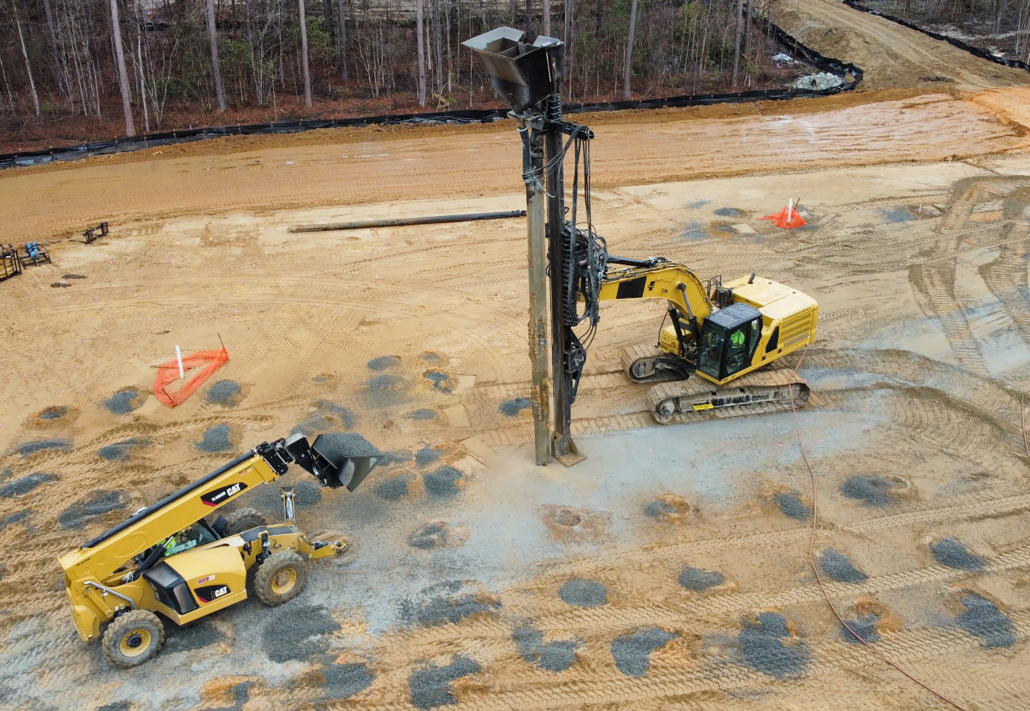
Aggregate piers, also known as Vibratory Stone Columns (VSCs), are columns of compacted stone installed into weak or compressible soils using specialized equipment.
Rather than transferring structural loads to deep bearing layers like traditional deep foundations, aggregate piers improve the engineering properties of the existing soils. This allows the soil and aggregate piers to work together as a reinforced composite ground system capable of supporting shallow foundations.
The result is improved soil performance with reduced settlement and increased bearing capacity.
How Aggregate Piers Improve Soil Performance
The effectiveness of aggregate piers comes from several engineering principles working together.
Increased Bearing Capacity
Weak soils often lack the strength needed to support structural loads.
As aggregate piers are installed, the surrounding soils are densified and confined while the compacted stone columns provide additional stiffness. This composite system allows loads to be distributed more effectively, increasing the allowable bearing capacity of the improved ground.
For many commercial projects, this allows engineers to design conventional shallow foundations where they might otherwise require deep foundations.
Reduced Settlement
Settlement is one of the primary concerns when designing foundations on soft or variable soils.
Aggregate piers reduce settlement by reinforcing compressible soils and limiting how much the ground compresses under structural loads.
By improving both the strength and stiffness of the soil mass, engineers can better control total and differential settlement across a building footprint.
Improved Load Distribution
Instead of concentrating structural loads at isolated points, aggregate piers distribute loads throughout the improved soil mass.
This creates a more uniform support system beneath slabs, footings, and foundations.
For large commercial buildings, this consistent support helps reduce differential settlement that can lead to cracked slabs, uneven floors, or long-term structural movement.
Enhanced Drainage
Stone is naturally free-draining.
Aggregate piers can improve groundwater movement within certain soil conditions by providing drainage pathways that allow excess pore water pressure to dissipate more quickly during and after loading.
This is particularly valuable in cohesive soils where consolidation can otherwise occur slowly over time.
Why Engineers Specify Aggregate Piers
From an engineering perspective, aggregate piers offer several important advantages beyond improving weak soils.
They can help:
- Reduce long-term settlement
- Increase allowable bearing capacity
- Improve overall ground stiffness
- Support shallow foundation systems
- Minimize excavation requirements
- Reduce spoils and imported fill
- Improve constructability
Because every site presents different subsurface conditions, geotechnical and structural engineers evaluate aggregate piers alongside other ground improvement methods to determine the most effective solution for each project.
Real-World Performance in Commercial Construction
The engineering principles behind aggregate piers are proven every day on active construction sites.
At the Pontoon Beach project in Illinois, CNC Foundations installed more than 3,400 aggregate piers to support a large warehouse development. The ground improvement solution increased bearing capacity while providing the foundation support required for the project’s expansive footprint. Early planning and efficient installation helped keep construction moving forward while addressing challenging subsurface conditions.
Similarly, the Appleton project in Wisconsin required ground improvement for a commercial development with difficult soil conditions. By designing and installing an aggregate pier system tailored to the site’s geotechnical characteristics, CNC Foundations helped create a stable foundation platform while supporting the project’s schedule and long-term performance.
These projects demonstrate that successful ground improvement is not simply about installing stone columns. It requires careful engineering, thorough site evaluation, and close collaboration between the contractor, geotechnical engineer, structural engineer, and project team.
Why Early Collaboration Matters
The most successful aggregate pier projects begin long before construction starts.
When ground improvement specialists are involved during preconstruction, the project team can:
- Review geotechnical reports
- Evaluate multiple foundation options
- Coordinate with structural engineers
- Optimize foundation design
- Reduce redesigns later in construction
Early collaboration often results in better technical solutions while reducing project risk.
Partner with CNC Foundations
At CNC Foundations, engineering drives every ground improvement solution we deliver.
Our in-house engineering team works closely with general contractors, geotechnical engineers, structural engineers, and developers to evaluate site conditions and recommend practical, cost-effective solutions that meet each project’s performance requirements.
Whether you’re designing a warehouse, manufacturing facility, distribution center, or commercial development, our team can help determine whether aggregate piers are the right solution for your site.