Turn on screen reader support
To enable screen reader support, press Ctrl+Alt+Z To learn about keyboard shortcuts, press Ctrl+slash
Turn on screen reader support
To enable screen reader support, press Ctrl+Alt+Z To learn about keyboard shortcuts, press Ctrl+slash


RIGID INCLUSION GROUND IMPROVEMENT FOR 135K SF INDUSTRIAL FACILITY
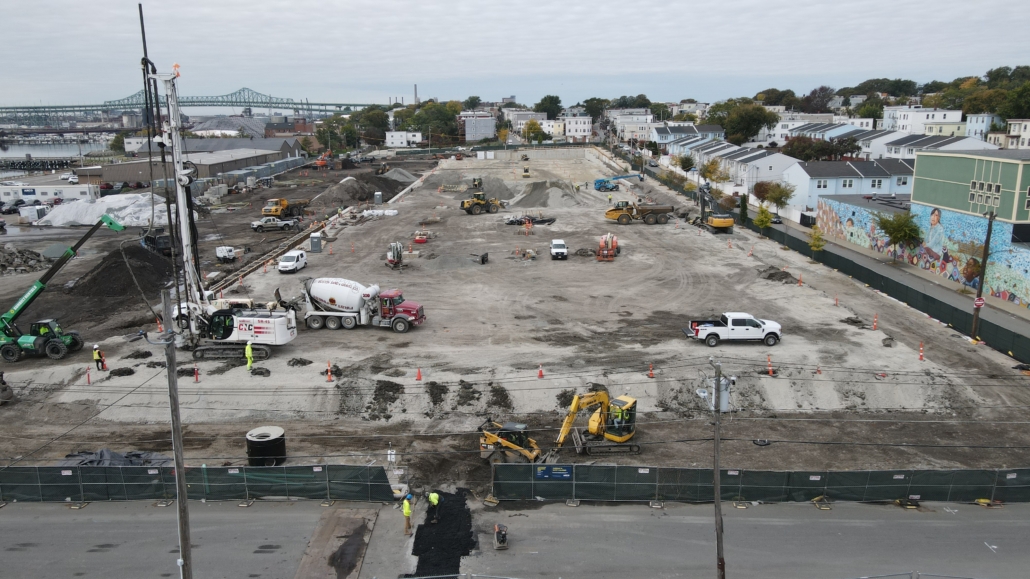
CNC Foundations (CNC) delivered ground improvement services using rigid inclusions to support Chelsea Point, a 135,000-square-foot Class A industrial facility in Winthrop, Massachusetts. Designed with a 36-foot clear height and flexible configurations for single or multi-tenant use, the structure is tailored for last-mile logistics and freight distribution.
Strategically located just two miles from Logan International Airport and three miles from downtown Boston, the site required a high-performance foundation system that could maintain stability in a dense coastal environment. CNC’s rigid inclusion solution ensured long-term geotechnical performance while preserving an efficient, low-disruption worksite.
Project Details
- Owner: Hines U.S. Property Partners
- General Contractor: ARCO National Construction
- Structural Engineer: H + O Structural Engineering
- Project Timeline: 42 Production Days
- Project Size: 135,000 SF
- Design Bearing Capacity: 4,000 psf
- Service: rigid inclusions
- Install Numbers: 1,900+ rigid inclusions at over 51,000 linear feet
- Market Sector: Manufacturing and Industrial
CUSTOMER’S REQUIREMENTS & CHALLENGES
The developer needed a foundation system capable of supporting heavy industrial loads on a site with highly variable, compressible soils, including marine deposits and uncontrolled fill. Traditional deep foundation options were cost-prohibitive, and the project required a low-vibration, performance-driven alternative that could meet strict settlement tolerances.
CNC Foundations recommended rigid inclusions as a sustainable, cost-effective alternative, minimizing spoil, reducing vibration, and optimizing efficiency while delivering predictable long-term support.
SOIL CONDITIONS
Subsurface investigations revealed a complex soil profile, including:
- 5 to 6 feet of very loose to medium dense granular fill
- Underlying natural deposits of medium dense to very dense sand and gravel
- Intermittent layers of very loose to very soft organic marine silt, clay, and fine sandy soils
- A transition to very dense sands beginning at approximately 35 feet adn extending up to 60 feet below grade
These variable conditions posed challenges related to compressibility, settlement risk, and lateral variability. The foundation system needed to penetrate soft soils and transfer loads into deeper, more competent strata to ensure uniform behavior across the footprint.
SOLUTIONS & RESULT
CNC Foundations installed over 1,900 rigid inclusions totaling over 51,000 linear feet to support the foundation system at Chelsea Point. Using a reverse flight displacement auger, each inclusion was drilled and pressure-grouted to create a reinforced column capable of transferring loads into stable underlying soils. A granular load transfer platform was placed above the inclusions to distribute structural loads evenly across the improved ground. The system increased allowable bearing capacity, controlled settlement within design tolerances, and enabled rapid, low-vibration installation, eliminating the need for deep foundations or extensive excavation.
The project was delivered on schedule, with testing confirming full alignment with geotechnical and structural requirements.