Turn on screen reader support
To enable screen reader support, press Ctrl+Alt+Z To learn about keyboard shortcuts, press Ctrl+slash
Turn on screen reader support
To enable screen reader support, press Ctrl+Alt+Z To learn about keyboard shortcuts, press Ctrl+slash

Aggregate Piers, Ground Improvement
Aggregate Piers for Warehouses, Distribution Centers, and Large-Footprint Buildings
September 4, 2026
For general contractors building warehouses, distribution centers, and other large-footprint facilities, the challenge below grade can have a major impact on what happens above it.
These projects often combine widely spaced column foundations with expansive floor slabs carrying storage racks, equipment, or other concentrated loads. When weak, compressible, or variable soils are present, the concern is not simply whether the ground can support the building. The foundation system also needs to control total and differential settlement across a very large area.
Aggregate piers are one ground improvement solution that may help address those conditions.
Aggregate piers are compacted columns of stone installed within weak or compressible soils to improve bearing capacity and control settlement. When the soil profile, structural loads, and project requirements are appropriate, aggregate piers can improve the ground enough to support conventional shallow foundations rather than transferring loads through a deep foundation system.
For general contractors, understanding where aggregate piers fit can help identify potential foundation challenges earlier and bring the right geotechnical partners into the conversation.
What Are Aggregate Piers?
Aggregate piers, also called vibratory stone columns or VSCs, are a form of ground improvement. Instead of bypassing weak soils as a deep foundation system would, aggregate piers improve the performance of the existing soil mass.
Stone is installed and compacted in vertical columns beneath planned structural elements. The aggregate piers and surrounding soil then work together as an improved ground system.
Depending on the project, aggregate piers may be installed beneath:
- Column footings
- Floor slabs
- Mat foundations
- Tanks
- Embankments
- Other heavily loaded areas
CNC Foundations uses different installation methods based on factors such as soil conditions, groundwater, and structural loading. These can include dry top-feed and dry bottom-feed installation techniques.
For a general contractor, the important distinction is that aggregate piers improve the soil rather than functioning as individual deep foundation elements.
Why Are Aggregate Piers a Good Fit for Large-Footprint Buildings?
Warehouses and distribution centers can place very different demands on the foundation system within the same building footprint.
Columns may be relatively widely spaced, while the slab between them must support significant rack loading, equipment, or storage. If the soil beneath one portion of the building behaves differently from another, differential settlement can become a major concern.
A CNC Foundations warehouse project in Peoria, Illinois illustrates the issue.
The proposed building measured approximately 400 by 600 feet with columns arranged on a 40-by-40-foot grid. Typical column loads were estimated at 56 kips, while the floor slab needed to accommodate storage rack loading of approximately 1,000 psf.
Below the building, however, the soil profile was highly variable. Fill materials extended to different depths across the site, with soft alluvial material reaching approximately 35 feet below grade. CNC identified the variability, low soil strength, and compressibility as conditions that could lead to significant differential settlement of both the column pads and slab.
CNC designed and installed an aggregate pier system to address those conditions, with on-site testing used to verify the design and settlement performance.
For a GC, this is an important example of why the conversation should extend beyond column loads alone. On a large-footprint facility, slab performance can be just as important as footing performance when evaluating the ground improvement strategy.
For more about how this approach applies to these types of facilities, explore aggregate piers for large-footprint buildings.
What Soil Conditions May Lead a Team to Consider Aggregate Piers?
Aggregate piers can be considered when near-surface soils do not provide the bearing or settlement performance required for the proposed structure but conditions may still be suitable for ground improvement.
Soft clays, silts, and uncontrolled fill are among the soil conditions where aggregate piers may be considered.
But soil type alone does not determine the solution.
The project team also needs to consider factors such as:
- Depth and variability of weak soils
- Compressibility
- Structural loading
- Required bearing capacity
- Settlement tolerances
- Groundwater
- Site access and equipment requirements
- Adjacent structures
- Overall constructability
This is why a geotechnical report that identifies poor soils should start a conversation, not automatically dictate a particular system.
For a deeper look at these considerations, CNC Foundations also discusses how aggregate piers can be used when building on challenging soils.
What Can Aggregate Piers Help a General Contractor Accomplish?
When supported by the geotechnical and structural evaluation, aggregate piers can provide several practical benefits for large commercial and industrial projects.
Improve bearing capacity
The compacted stone columns reinforce the surrounding soil and create a stronger composite ground system capable of supporting greater loads than the unimproved soil alone.
Control settlement
Settlement is often a critical consideration for warehouses because of the combination of structural foundations and large slab areas. Aggregate piers can be designed to reduce both total and differential settlement within required project tolerances.
Maintain shallow foundation construction
Where conditions are appropriate, improving the soil may allow the structural design to continue using shallow footings instead of moving to a deep foundation system.
That distinction can have significant implications for how the GC plans and coordinates the foundation package. It should, however, always be based on site-specific engineering rather than assuming aggregate piers will replace deep foundations on every project.
Address varying conditions across a large site
Large industrial developments do not always have a uniform soil profile.
At CNC Foundations’ Gaston Commerce Center project in Gastonia, North Carolina, subsurface conditions varied enough that one system was not appropriate across the entire improvement area. Aggregate piers were used in areas with moderate soil strength, while rigid inclusions were installed where softer or more compressible soils and higher loads required reinforcement into deeper, more competent layers.
Sometimes the most effective ground improvement strategy is not choosing one technology for the entire site, but matching the system to the conditions encountered across it.
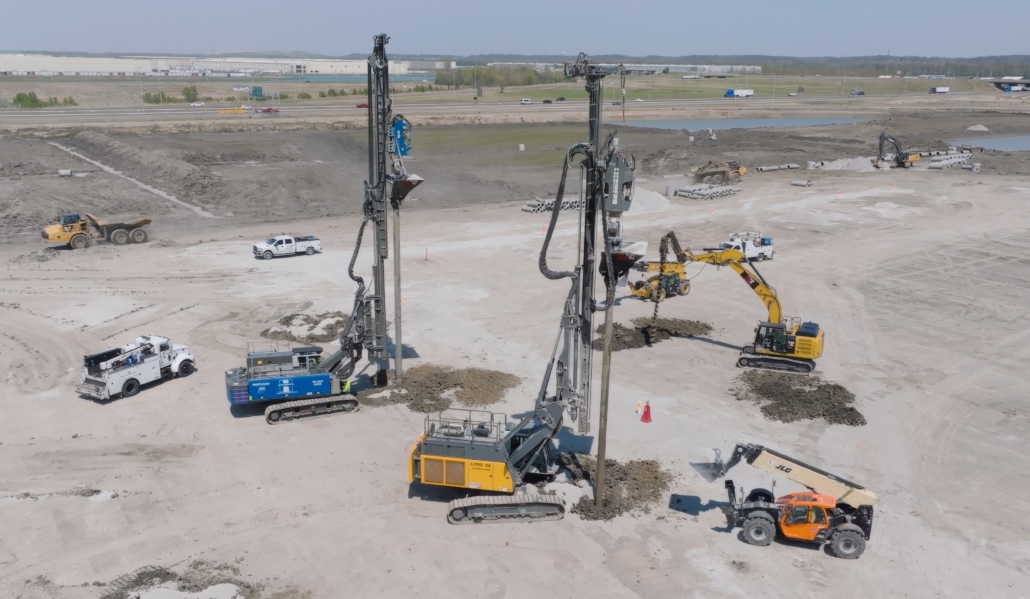
What Does Aggregate Pier Installation Look Like at Distribution-Center Scale?
The scale of a large distribution center makes installation planning especially important.
On large industrial projects, aggregate pier systems may require hundreds or even thousands of individual elements across expansive building footprints. Installation sequencing, stone delivery, equipment movement, testing, and coordination with other site activities all become important considerations for the GC.
The takeaway is not that every large warehouse needs the same quantity or configuration of aggregate piers. It is that ground improvement can be designed around the scale and loading requirements of a large-footprint facility when the subsurface conditions and structural design support the approach.
When Might Another Foundation Solution Be More Appropriate?
Aggregate piers are versatile, but they are not the right answer for every site.
Some projects may require a different ground improvement technology, such as rigid inclusions, while others may require a deep foundation system that transfers structural loads through weaker soils to competent material or rock below.
This becomes particularly important when a project includes:
- Very soft or highly compressible soil zones
- Significant variations in improvement depth
- Higher structural loads
- Tight settlement criteria
- Challenging access or installation constraints
- Conditions requiring load transfer to deeper competent materials
For GCs, the key question should not simply be, “Can aggregate piers work here?”
A better question is, “What system gives this project the required foundation performance based on the soil profile, structural loads, settlement criteria, and construction constraints?”
When Should a General Contractor Bring in an Aggregate Pier Contractor?
Earlier coordination can be valuable when the geotechnical report identifies soft, compressible, uncontrolled, or significantly variable soils.
An experienced aggregate pier contractor can review the geotechnical information alongside structural loading and project requirements to determine whether aggregate piers should be evaluated further or whether another ground improvement or deep foundation solution may be more appropriate.
CNC Foundations combines in-house engineering with field installation capabilities, allowing the ground improvement design and construction considerations to be evaluated together. CNC has provided geotechnical design and installation services on projects across the country since 1987.
For a GC, that early evaluation can provide a clearer understanding of what the foundation package may require before construction reaches the point where below-grade conditions begin affecting field operations.
Evaluating foundation options for an upcoming project? Connect with your local Business Development Manager to discuss your site conditions and determine whether aggregate piers or another ground improvement solution may be appropriate for your project.